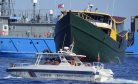





South Korea’s denial of entry to three Japanese lawmakers attempting to visit the disputed islands of Dokdo/Takeshima is the latest in a long series of tit-for-tats between the two countries.
The rocky outcrop, known as Dokdo in South Korea and Takeshima in Japan, is considered by both countries part of their own respective territories, and the dispute over them has been an ongoing spoiler in bilateral relations. Last month, the Japanese government told its Foreign Ministry staff not to use Korean Airlines for a month, in response to the company’s decision to conduct the inaugural flight of its A380 passenger jet above the isles.
The Liberal Democratic Party lawmakers’ attempt to enter ‘Dokdo’, via South Korea, meanwhile, had been long anticipated. Indeed, the Lee Myung Bak government in Seoul had advised the conservative Japanese politicians to refrain from visiting, given the heated civil response it would elicit throughout South Korea.
On the face of it, the two countries have every reason to overcome this seemingly petty territorial dispute and reach an agreement over resource sharing in their neighbouring waters. Given how much there is at stake in Northeast Asia – North Korea’s nuclear ambitions, rivalry between the United States and China, latent military hostilities across the Taiwan Strait – the two countries would do well to move past the Dokdo/Takeshima dispute and instead focus on the big picture of peace and stability in Northeast Asia.
However, to try to understand South Korea-Japan relations by focusing on the dynamics of the contemporary relationship is to get things upside-down. Add in an entanglement of historical regional resentments and a very important truth emerges: from the South Korean perspective, the dispute over these rocky outcrops is the big picture.
The emotional potency of the ‘Dokdo’ issue in South Korea reveals just how powerful historical memory is. This issue brings together all Koreans, no matter what their political inclination – a rare occurrence in a country that is itself deeply ideologically and politically divided.
It’s this historical memory that is responsible for Korea’s unwillingness to take this dispute to the International Court of Justice (ICJ). From the South Korean perspective, losing ‘Dokdo’ would be akin to the post-facto legitimization of Japanese colonial rule. On the one hand, Koreans think that as long as they have effective jurisdiction, there’s no point taking the risk that they may lose the islands. But more importantly, referral of the case to the ICJ appears to concede that Japanese claims to the islands are valid.
For Koreans, then, this latest incident invokes strong nationalist sentiments and lingering resentment over the war crimes committed by the Japanese during their occupation of the peninsula. Thus, while outsiders counsel calm and meeting half-way, this will be a very difficult sell for the Lee government under current circumstances.
It’s important to understand the strong emotional significance of the islands and the role that national identity plays – in both countries, but particularly in Korea. Any concessions on the part of Korean lawmakers would be akin to political suicide, and so they are unlikely. Likewise, it’s improbable that Japan will simply stand back from the dispute and hand over sovereignty. It’s also clear that, for as long as the two countries remain unable to even begin public conversations over the matter, diplomatic relations will improve only very slowly, if at all.
Conversations need to begin and they need to go straight to the core of the issue: an acknowledgement of how deeply the Japanese occupation of Korea strikes at the heart of national identity in that country, and the symbolic role that the Dokdo/Takeshima island dispute plays in this.
A solution thus demands that Japan take the first step and acknowledge that Korean claims to the territory are closely linked to historical resentments over the behaviour of colonial Japan. Japan’s annexation of the islands was among the first in a series of actions that led to the colonization of the peninsula, and Korean outrage to Japan’s ongoing claims to the territory has everything to do with this and little to do with the legalistic historical arguments the Japanese have been putting on the table to support their claims.
The South Korean government must for its part be able to demonstrate to its citizens that Japan isn’t ignoring the link between their claims to the islands and the 20th century colonization of the country. Only then can the leadership in Seoul stop the reactive decision making and make bold efforts to shift the domestic conversation about how to move forward with the Japan-South Korea relationship. After all, cooperation between these two countries is in the interests of the entire region.
Dong-Joon Park is a Resident Kelly Research Fellow at Pacific Forum CSIS. Danielle Chubb is a Resident Vasey Research Fellow at Pacific Forum CSIS.


Gerry Bevers
There are many problems with this article.
First, the Japanese lawmarkers did not go to Korea to visit “Dokdo” (Takeshima). They went there to visit the Dokdo Museum on the Korean island of Ulleungdo, which is about ninety kilometers northwest of “Dokdo.” The museum houses maps and documents that Koreans say support their claim to “Dokdo.” The Japanese stated that they had no intention to visit the disputed islets.
Second, Korea refuses to take the dispute to the International Court of Justice (ICJ) not because Koreans have some “powerful historical memory” of Japanese colonial rule, but because Korea has no maps or documents to support any historical claim to “Dokdo.” In other words, Korea knows the ICJ would rule against her.
The reason Korea has no maps or documents is that her claims were all fabricated shortly after World War II with the hope that she would be able to gain Japanese territory, which included not only “Dokdo” but also the Japanese island of Tsushima. The United States, however, rejected Korea’s claims. In an August 9, 1951 letter to the Korean ambassador, US Secretary of State Dean Rusk wrote the following.
“As regards the island of Dokdo, otherwise known as Takeshima or Liancourt Rocks, this normally uninhabited rock formation was according to our information never treated as part of Korea and, since about 1905, has been under the jurisdiciton of the Oki Islands Branch of Shimane Prefecture of Japan. The island does not appear ever before to have been claimed by Korea….”
Korea never even attempted to provide the US with evidence to support her claim. Instead, Korean President Syngman Rhee simply declared “Dokdo” after the 1951 Treaty of Peace with Japan allowed Japan to keep the island.
After visiting the Far East in 1954, US Special Mission Ambassador James Van Fleet wrote the following in his post-mission report:
The Island of Dokto (otherwise called Liancourt and Take Shima) is in the Sea of Japan approximately midway between Korea and Honshu (131.80E, 36.20N). This Island is, in fact, only a group of barren, uninhabited rocks. When the Treaty of Peace with Japan was being drafted, the Republic of Korea asserted its claims to Dokto but the United States concluded that they remained under Japanese sovereignty and the Island was not included among the Islands that Japan released from its ownership under the Peace Treaty. The Republic of Korea has been confidentially informed of the United States position regarding the islands but our position has not been made public. Though the United States considers that the islands are Japanese territory, we have declined to interfere in the dispute. Our position has been that the dispute might properly be referred to the International Court of Justice and this suggestion has been informally conveyed to the Republic of Korea.
While Korea has no old maps showing “Dokdo,” by any name, or any documents showing that Koreans ever visited the islets before the Japanese started taking them there as deckhands on Japanese fishing boats in the early 1900s, Japan has maps of the islets dating back to the 1600s and documents clearly describing them. Also, Japan officially incorporated “Takeshima” (Dokdo) into Shimane Prefecture in February 1905 after receiving a 1904 request to do so by a Japanese fisherman who was using the islets to capture and process sea lions.
The incorporation of Takeshima had nothing to do with the colonization of Korea. The islets were just a small group of rocks that had little or no strategic value and were not a part of Korea, so it is wrong for the writers of the article to write that “Japan’s annexation of the islands was among the first in a series of actions that led to the colonization of the peninsula.”
Korean “outrage” over Japanese claims to “Dokdo” is the result of about sixty years of fabricated Korean propaganda. It is not Japan who refuses to discuss the issues in the dispute; it is Korea. To solve the problem, Korean historians need to start telling the truth about the history of “Dokdo.”
settleinHague
The Japanese lawmakers had announced their plan to visit the Dokdo museum on the island of Ulleungdo, and the Japanese government too had requested the Korean government to ensure the safety of those lawmakers. By denying their entry, the Korean government demonstrated its unwillingness and/or inability to control the heated domestic response which was not civil. As Gerry Beavers says in his comment above, Korea’s claim to the islets has no historical or legal basis. Please watch the following video entitled “Does there exist any old Korean map which depicted Takeshima/Dokdo?”:
http://www.youtube.com/watch?v=H91QN6ho8jU&feature=related
Nick
Gary, you misinterpret why Korea would not want to bring this forward to an international tribunal. Korea has full jurisdiction over the islands and bringing this to some type of arbitration would only open Korea up to a result of less than full jurisdiction – all downside, little upside.
We all know how courts work, the larger and richer party (Japan) will generally prevail or will win undeserved concessions. Imagine your wife was murdered and you are wrongfully considered a suspect. Would you want to go to trial to clear your name? Or would you rather avoid a trial, because we all know courts can be unreliable? Going to trial would be all downside and little upside for you. Use your head, man.
GMander
http://en.wikipedia.org/wiki/Liancourt_Rocks_dispute
Gerry, this wiki entry seems to dispute your claim that Korea has no evidence to support its ownership of the islands. In fact, your excerpt from Dean Rusk references the fact that in 1905, Japan unilaterally annexed the islands. If you recall your early 20th century history, Imperial Japan had a habit of illegally annexing its neighbors’ territories, which was illegal and did not stand the test of time. Do you remember WWII?
smdfbsdk
what do u mean there no evidence? i saw an old map from china? which indicated that Dokdo is COREAN… by the way I hate japanese who believes ” Even if it is a lie if you lie a hundred times it becomes the truth”…. I heard that it was one of Japenese’ moral…..Well… my fav. Korean moral is if you lie sooner or later you will be caught red handed…If dont know, dont make things up and keep quite
OMG
Why do you think there are no Korean documents? Because the Japanese burnt them all in their barbaric colonization attempt over the Korean peninsula. If you look at any map from Japan or China before the colonization, it clearly says that it is Dokdo. It’s not Korea who has been fabricating history, it’s Japan. Do you know, at this moment, Japanese kids are learning fabricated history? I salute Japan for their ability to fabricate anything.
alex
gerry bevers,
I never heard such a ignorant comment like this, i think you must study history(real history) not by japanese fabricated one, but by korean ancient history and even the european one that traveled in the 17 century to asia and made a map byself.
I think is better you keep quite!
kuldeep
japan and south korea are allies and should share the islands under US nuclear umbrella. Infact phillipines south korea and japan should merge to form a single entity because they anyhow do not matter nowa days and are under the protection of US specially when both japan and south korea have lost their sovereignity long back to US of A.
jfhbsdcksbckjsd
What do you mean by share???
What if I asked you can I share your husband/wife with you???
Would you agree to it?
Or would a mother let someone to share her own baby with the person who constantly tries to hurt her child???
Haha
Japan has been lobbying to US, investing millions of dollars into US-related projects. Of course the US would take Japan’s side, ignoring history if they have to. Every Japanese Map since the present maps have acknowledged Dokdo as Korean territory. They just want the riches they can gain from Dokdo.
John Chan
To solve territory disputes in the world peacefully, de jure sovereignty should prevail; ICJ should support de jure sovereignty over de factor sovereignty.
China has oldest and comprehensive written documentation on history, geography, etc. If Korean and Japanese cannot sort out their dispute regarding Dokdo/Takeshima, both nations should seek help from China to provide impartial expert opinion on Dokdo/Takeshima. Both Korea and Japan should exclude the involvement of USA, because USA is known to make everything a pigs breakfast so it can profit from the chaos handsomely.
Don Johnson
Some people(aka John Chan) have been arguing that Korea and Japan should follow the Chinese Document in order to solve this controversial topic. It is true that Chinese have one of the most comprehensive and largest written document regarding the history of their nation, as well as others that have shared relations with, but people should remember that quantity does not ensure quality. Did you know that the Chinese government is deliberately altering some of its historical facts and events and concealing some inconvenient truth? Of course, it is for their nationalistic benefit of strengthening their citizens’ unity by purifying their historical image. THis shows that the impartiality of the document clearly fails.
please do some research before typing.
mareo2
With all due respect, in my humble opinion to refuse to solve the dispute in the ICJ, looks just like to refuse to start paying a tax for saving money for pay the huge cost of the future reunification of Korea. North and south korean people know very well what is the right thing to do for improve the peace, stability and economy of the region. But despite how much sympathy I can feel for all their past sufferings and the guiltiness for what my own country did, it seems to me that most people find more “convenient” to keep the present status quo of unsolved conflicts in every front for ever, while blaming others for not “understand their emotional but unreasonable refusals” and overshadow that they stubbornly are taking the wrong moral choices in the long-term.
Beret
This is so Korea when something is established they come in and try to claim it theirs, no sweat and blood is put into the development but they jsut want to move in and claim ownership. Dokdo Island has alway been Japanese…
jane
wat means so like korea?
koreans always have been hard working 2 save korea economy which went really bad because of japan’s rule of Korea. don’t talk of koreans as if tey r thieves if u don’t know well about it.
and with wat evidence u say that dokdo is japan’s land? when it is administered by korea at present.
Sally
Dokdo island has always been korean. Japanese took korean territory(Dokdo) without their agreeement when they took away korean’s soverenity. Japanese did return Dokdo after the WW2. I hate recent attitude from Japan. They even claim that Dokdo is their land on their legal document. Dokdo is clearly korean’s not japanese’s.
Nick Henry
While I lived in South Korea for a time I would often hear my Korean friends talk about this island with a great deal of pride.
Anyone ever having been to South Korea in recent years will tell you the largest currency denomination is about $10. A $100 bill or (100,000 W) was set to be released into circulation a few years back but was rejected because the map displayed on it did not show Dokdo.
I purchased a “balloon-hammer” when I was there and proudly displayed on the side of the hammer, (translated) read “Dokdo is Our Island”
Beret
Dokdo belongs to Japan just like Oki Island.Koreans speaks of the island but has done nothing, they always want what they cannot achieve. Last minute claims oh, its our island when Japan has inhabited this island for century, now its developed they want to stake claims. It has been an ungoing thing for Korea claim what’s not your because you are entitled.
Seol
Hi, you said that the island has been always Japanese’s territory.
However the most important thing that could help you to understand that
it has ‘NEVER’ been Japanese’s is that no single Japanese has not been able to go
to Dokdo Island without passport.
Unlike all Japanese needs passport to visit Dokdo Island, all Korean can go to island without any problem.
Lin
Actually, even on Japanese maps dating from centuries ago, they have marked Dokdo as “Dokdo”, meaning, Korea’s land. Of course, they didn’t know back then what riches the island of Dokdo and it’s surroundings can bring. So now, after centuries of acknowledging that Dokdo is Korean land, they are saying it is rightfully Japanese, and even putting false information in HISTORY TEXTBOOKS, so all Japanese students will grow up leaning the wrong things. This is WRONG. This is thievery. But then, what would you expect from them.
Kevin
Japan is saying that east sea one in china and russian island is their. such a stealer.. country of moneky
steven j barber
Beret, Dokdo (Takeshima) has never historically been Japanese. It was seized by their navy island during the Russo-Japanese War in 1905. Japan’s claim to Dokdo is inseparable from their colonization of Korea.
Numerous Japanese records prove Oki Island’s were the territorial limit of Japan throughout the ages. No Japanese documents or maps are proof of title over the islands.
http://www.youtube.com/watch?v=3rp3Cb-NH9A
For the truth of the Dokdo Takeshima dispute go to…
http://www.dokdo-takeshima.com
Rafa
My God…Japan has gone too far. I’m Chinese, and I fully support Korea in its efforts against Japan’s hubris. The Japanese really need a lesson in humility. It has to appreciate what it already has, and not lust for more.
LOL at Japan
I heard Japan is going to sink midway through this century. Maybe that’s why they are desperately trying to rip lands off other countries because obviously they are running out of sand to make artificial coasts. Or they may be looking to extend their sea territory to hunt more whales and dolphins.
Japan should stop this savagery. It’s yuck. Korea sends foreign aid and huge sum of money to help Japan with their Earthquake recovery and a couple of months later they announce this madness. This shows Japanese culture of bowing and being thankful and all that nonsense is all but hypocritical in their inner ambitions and insatiable greed. Their manipulation of history is disgusting and this is going to lead to a state where no one in Japan is unable to see the truth and rely on their ability to create their own world of self-indulgence in the false knowledge.
I hate this recent “it’s ours” attitude from Japan. I agree, as the article says, in this heated debate, the world is unable to know who right. But who cares? Look at reactions from Korea and Japan: why is Korea upset and Japan isn’t? It just feels like some Japanese rand coming into your house and claiming its theirs with a straight face. Japan should get their mitts off other people’s land. They should remember what their territorial greed earlier in the 20th century led to.
Sally
If Dokdo belongs to Japan, than all islands that Japan once ruled during the WW2 have to be territory of Japan. The objective of Japanese is to get natural resources of Dokdo which have value of approximate trillion dollar and other islands they ruled. Japan should remember what they did before and should have time for self-restraint and self-reflection.