

Back in 1997, the Association of Southeast Asian Nations formed ‘ASEAN Plus Three’ as a way of including East Asia’s three largest economies – China, Japan and South Korea – in the 10-member body.
Greater integration amongst Asian states was seen as essential in the wake of the financial crisis that rocked the region that same year, a crisis most ASEAN members were ill-prepared to cope with. More than a decade on, the most interesting question is arguably the role of China in the organisation, and specifically whether it plays a ‘dominating’ role or a ‘co-operating’ with other members.
One recent report on the issue notes that China’s non-traditional security (financial disorder, cyber-attacks, health epidemics, nuclear proliferation etc.) relations with ASEAN are thriving, and encouraging further cooperation among all involved. Indeed, there’s no shortage of evidence that as China has risen to prominence on the international stage, it has engaged in diplomatic benevolence – what some dub ‘soft power’ – to craft a widely successful foreign policy on a bilateral basis with individual Southeast Asian states and on a multilateral basis within ASEAN.
The ASEAN-China Free Trade Area (ACFTA) is the foundation on which China-ASEAN ties are based upon. As one observer has noted, political leaders in Beijing have been able ‘to convince its Southeast Asian neighbours that Chinese economic growth is good for them too, and thus increases the degree of interdependence between them.’
A telling comparison is with Russia and its fellow members of the Commonwealth of Independent States (CIS). The economies of Russia’s neighbours in the CIS are tied to Moscow, and are thus reliant and dependent on Russian planners. Russia has prioritized its own interests above greater integration, and so the economies of many of the former Soviet satellite states have suffered during an era of globalization.
China and ASEAN’s relationship, in contrast, is mutualistic, and the ACFTA has resulted in greater regionalism on China’s part and greater integration between Beijing and ASEAN member states. Foreign policy analyst Evelyn Goh goes as far as to say that China’s role within ASEAN and ASEAN Plus Three has demonstrated to the organization’s member states that they have nothing to fear from a rising China and, in fact, can expect additional benefits the larger the role China takes on:
‘While they may be wary of Chinese domination, many Southeast Asian leaders believe that the region suffered when China was weak and divided, and they are more optimistic about a growing, self-confident China that embraces capitalist values…Southeast Asia has been enthusiastic about Chinese regional activism because it advances the region’s two critical strategic imperatives. First, because of an intense post-independence struggle for regional leadership between Indonesia and Malaysia, the core regional security principle of ASEAN has always been the prevention of intramural hegemony. In addition to preventing the exercise of regional hegemony by any one external power, ASEAN has been committed to diversifying the region’s dependencies.’
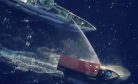
Still, China has shown that it won’t simply roll over when it feels its interests are threatened, the clearest example being China’s aggressiveness in the dispute over the Spratly Islands. China has maintained that the sea has been its sovereign territory for centuries, a claim disputed by a number of ASEAN countries. The Philippines and Vietnam, for example, have dispatched drilling tankers to the area to search for oil and natural gas reserves, and they cite the UN Convention on Laws of the Sea and the treaty’s clause pertaining to exclusive economic zones as evidence that China is violating international law. As has been noted in recent months in The Diplomat, there have been several incidents and public exchanges between China and other parties to the dispute, raising tensions to their highest levels in years.
So, are the parties involved doomed to conflict? Not necessarily. Recent reports suggest that China may be willing to resolve this dispute through ASEAN’s regional conflict resolution mechanisms – a stark contrast with Russia, which has tended to try to dominate weaker states in its sphere of influence through economic exploitation and military intervention.
Another question is whether, as its economy continues to grow, China’s regional policies will follow a similar approach to that of the United States within international organizations – will it try to dominate organizations the way Washington has sought to do, or will it follow the more cooperative and nuanced approach that it has taken with its ASEAN neighbours?
Beijing’s generally proactive approach to regional ties give at least some hope that China could, as it rises, become a benevolent actor on the global stage – which would surely be a good thing.
Tim LaRocco is a graduate student of international relations at The City College of New York. He has travelled throughout the developing world, including stints as a volunteer worker in the Public Parks Department in Chiang Mai, Thailand, and as a researcher for the South African Human Rights Commission in Cape Town. He currently lives in Long Island, New York.


nirvana
Tim Larocco concludes his analysis with a question and a positive hope. The key thing to remember is that under the wings of any “peaceful rise” or harmonious economic development there is an unavoidable accompanying military build-up. Whether such military force can be kept under control of responsible statemen or will it hatches its own “economic growth” logic when it gets to a critical point is the most important factor to monitor and predict.
Although a Russian fighter jet has shot down a Korean civilian plane, one good point nevertheless for the Russian tank men is that, when it came to shooting their own people, they preferred to disobey.
John Chan
ASEAN nations and China are the equal partners in the South China Sea; they should respect each other and work for a common goal to improve the peace and prosperity of the area. Any ASEAN member wants to take advantages of other partners because its greed, that nation surely has no interests of other nations in SCS in heart, ASEAN and China must take action to restrain such rogue behaviour for the good of the area.
For the moment Vietnam and Philippines are behaving oddly and endangering the peace and prosperity of SCS sphere. It seems their ex-masters have some kind of neuropsychological control over their minds and making them to do the bidding for their ex-masters to undermine the peace and prosperity of SCS sphere.
nirvana
@John Chan,
For my ignorance, can you explicit and pinpoint where in the disputed waters did the Vietnamese and Philipines behave oddly?
If I am Machiavel, I would agree with you that Vietnam and the Philipines are behaving oddly, for if they are really wicked, they should not challenge the nine-dotted line claim. If they are really rascals they should use the nine-dotted line as their safety insurance because without it the US has to stay out by their own repeated declarations of not taking side in territorial disputes.
As far as the equal principle is concerned, can you explain the following declaration of his excellency Yang Jiechi?
“China all along believes that all countries, big or small, are equal. China, being a big country, also has its legitimate concerns.”
a_canadian_observer
@nirvana: You beat me to it. I too await John Chan’s response to your questions. Although, I have to admit that I wouldn’t be that diplomatic.
Sinodefender
Vietnam bases claims on French claims which is illegitimate… Is it illegitimate to kick out foreigners from fishing,or stopping their ventures? China wants bilateral talks is that not fair? Involving countries that have nothing to do with the disputes ie U.S. is unfair?
nirvana
@Sinodefender,
When you talked about Vietnam’s claims that are based on the French’s (colonial), you had in mind the claims on the islands (islets or reefs). I am waiting for John Chan answer, but I doubt that the places of the recent fritions at seas have anything to do with these respective claims.
Due to my unfamiliarity with the Vietnamese government’s claims, I can not say whether they base their claims SOLELY on the French’s documents. I do not exclude that there is some greed from each and every claimants. I won’t expect the contrary in fact. The recent joint submission of Vietnam and Malaysia to UNCLOS seem to indicate nevertheless a willingness to resolve the disputes using a common core set of rules, which means making concessions on “indisputable” sovereignty. Because I agree with pro-China bloggers (and anti-China bloggers too): when it is question of sovereignty, there is nothing to discuss, but only to negotiate= bully or bluff.
Because I am also unfamiliar with the Chinese government’s claims, I wonder whether you would like to have a frank discussion with me to convince me and other bloggers that it is legal for China to have sovereignty over the waters, seabed and all features within the nine-dotted line? This is what I am interested most to find out at this point in time.
Sinodefender
French claims are based on how Vietnam emperor Gia long took control in 1816 and how Minh Mang built temples. Chinese claims are based on how the island was inhabited by Chinese during the Tang, and many historical records. Chinese view French claims(now Vietnamese) claims as illegitimate because France signed the Sino-French treaty of 1887 which stated any lands east of the Sino-Tonkin delimitation line belonged to Qing. July 3, 1938 France invaded the islands despite Chinese protest. WW2 Japan takes over the islands and when they lost they gave the islands to ROC. However since the Chinese Cival War happened French and Chinese communist waged naval warfare and gained Woody Island and the Macclesfield Bank. Phạm Văn Đồng the premier of North Vietnam, sent a letter to Zhou Enlai recognizing the 12 nautical lines. However this is disputed since North Vietnam was commenting on South Vietnam’s territories. PRC regained the Paracel’s after a skirmish with South Vietnam. When China and other SEA claimants signed the UNCLOS they all except Brunei agreed to leave the SCS disputes out of the UNCLOS. China’s claim to the 12 nautical miles was established by the KMT, then modified by PRC. China tries to establish its claims by using records but opponents question the legitimacy of those records.
nirvana
@Sinodefender,
Your 2 arguments using the 1887 demarcation line in the Sino-French Convention and the episode of Phạm Văn Đồng’s letter to Zhou EnLai is interesting. I will take them to show how you can be misled easily by propaganda, without looking-up at the details (and with the Internet you have no excuse for not doing a due-diligence search).
Let’s start first with the 1887 demarcation line (which indeed is West of the disputed features in SCS).
First, you must ask yourself the question why they (Napoleon Emperor and Qing Emperor) signed this agreement. You should read about the Sino-French War here
http://www.chinaahistoryofwarfare.com/blog/530566-the-sino-french-war/
Then, after you have grasped the context, you must read the Convention text. Conventions are very binding texts and so one can expects that they are worded with care (not like China’s Foreign Minister declaration that is intentionally crafted to be interpreted in various ways: a threat or a benevolence). The Convention text is here: http://www.chinaforeignrelations.net/node/167
You do not need to go very far. The title is “CONVENTION CONCERNING THE DELIMITATION OF THE BORDER BETWEEN CHINA AND TONKIN”.
“CHINA AND TONKIN”, AhA! This sets the scope of the Convention (and therefore the extend of the demarcation line. Look-up a map of Tonkin if you are not familiar what this means.
So, tell your pro-china blogger to continue saying that France gave Paracels and Spratlys to China in 1887 if they want to weaken the credibility of China.
Shall we continue with the 1958 letter by the then Vietnamese prime minister or you want us to continue debating my points above?
nirvana
@Sinodefender,
Please ignore the sentence “So, tell pro-China… if they want to discredit China.” in my previous post.
I should not be sarcastic. I truly apologise.
nirvana
Some thing strange… My first post of yesterday, an answer to Sinodefender, did not get through. It was a rebuttal of the claim that France gave Paracels & Spratlys to China in 1887. The second, apologising for my agressiveness vis-a-vis pro-China bloggers did. Apologies that I reiterate here. I will try re-posting a short version later.
nirvana
Ok it is published (thanks to the Moderator).
The Sino-French War is a period that today’s Chinese and French (Vietnamese too), can not be proud of. But this is not a reason to forget it, because when you forget History it will be distorted. The 1887 Convention is irrelevant to Paracels and Spratlys.
We can move on perhaps to the argument based on the 1958 diplomatic note of PVD, the then Vietnamese PM, to ZEL, the then Chinese PM. I do not want to deal with arguments like “PVD did not have anything to give because France had already given to China”. Do we agree?
nirvana
@Sinodefender,
I find it interesting to debate with you, Sinodefender, because you truly believe in what you say.
It is plausible that, in 1883 the Qing Emperor claimed SOMETHING in the SCS. But I propose that we concentrate on one argument at a time. We were discussing the 1887 Convention and whether it gave Paracels and Spratlys to China.
I have demonstrated that this Convention’s scope was the Tonkin. The Tonkin is a region well above the 17th parallel. The sea demarcation line in the 1887 China-Tokin Convention, although based on a meridian, can not be interpreted as extending further South, to cover the Paracels and Pratlys. Just for demonstration, even so extended, it can not be interpreted as “anything West for me, East for you”. For then everything belong to both parties, the world being round! Still another argument to show the absurdity of this interpretation: the French having the upper hand in the war, why would they give an open-ended sea on the East of the line and contend with a closed part, infinitely smaller, on the West?
Now, if you restrict the Sino-French split to the Tonkin Gulf, you can see that the French got a much larger piece of the cake; in other words, they negotiated in “position de force”. Let’s look at how Vietnam and China settled their Tonkin Gulf border in 2000. This new border follows roughly the guiding principles of UNCLOS. Compared to the Sino-French split, China gets today more sea area in the Tonkin Gulf than they got in 1887, and most of importantly, a number of oil fields that were on the West of the 1887 line. Do you see what I try to arrive at?
nirvana
@a_canadian_observer,
Thanks, but I think you should try to be diplomatic too.
Imagine you meet A. Hitler tommorrow in front of your door. Do you think it is productive to insult or even to assassinate him? If he can manipulate millions to join his Nazy party, bashing him is like the hero, Neo, of the Matrix trilogy films doing Kung Fu with “agent Smith”.
You have to get to the “core”. You have to ask yourself why people believed in Hitler’s rhetoric. And when you understand that there is a little bit of truth, and that he was playing with this truth and the feeling the German citizens after WWI to advance his agenda, like Neo you will find the solution.
Re-watch and enjoy Matrix. This is my light note of today!
a_canadian_observer
@nirvana: I really appreciate your comment to me re. being diplomatic. I have to admit, I’ve felt upset every time I read the CCP propaganda mouthpieces that distort the truth in trying to bully and rob from the smaller nations. However, I will try to take your advice. BTW, have you noticed that John Chan has not responded to you?
Sinodefender
The origins for this war is greed France wanted to maintain ties in Indochina and Qing thought to maintain suzerainty of Annam resulting in loss of face for Qing. My bad I thought the Tonkin gulf was larger… If truly the islands weren’t Qing territory then why did Qing complain of Germans investigations. However it seems the Paracels are East of the delimitation line South of Hainan. Phạm Văn Đồng agreed to China’s 12 nautical mile is that North Vietnam needed Chinese aid. However since the islands and sea were in South Vietnam’s jurisdiction it was illegal. But didn’t North Vietnam reunite Vietnam? Thus they have the same government and the letter should be honored. Chinese government complained to France about the Paracels, French troops ignored Chinese protests and invaded July 3, 1938. Chinese regained the islands after WW2 when Japanese gave up claims.
Sinodefender
The origins for this war is greed France wanted to maintain ties in Indochina and Qing thought to maintain suzerainty of Annam resulting in loss of face for Qing. My bad I thought the Tonkin gulf was larger… If truly the islands weren’t Qing territory then why did Qing complain of Germans investigations. However it seems the Paracels are East of the delimitation line South of Hainan. Phạm Văn Đồng agreed to China’s 12 nautical mile is that North Vietnam needed Chinese aid. However since the islands and sea were in South Vietnam’s jurisdiction it was illegal. But didn’t North Vietnam reunite Vietnam? Thus they have the same government and the letter should be honored. Chinese government complained to France about the Paracels, French troops ignored Chinese protests and invaded July 3, 1938. Chinese regained the islands after WW2 when Japanese gave up claims. Everyone who thinks I’m a brainwashed Communist is false, I don’t even live in China.
Tom Tran
Who are at odds with the rest of the world? China, Vietnam or the Philippines? if you cannot answer my question first then you should stop blame others now. Remind me when China could find any international partner to accept its interpretation of the laws of the sea. In fact, China has territory conflict with all of its neighbors including Vietnam, ASEAN, Japan, Russia, Korea, India, Taiwan, Tibet, Mongolia is evidence that you are not at all connected to the real world. It’s better to open your eyes to see and share the common with the rest of the world rather than just your “comrades”. Whoever lives with their self-imposed fantasy only gets isolated whenever it comes to a frank and fair debate. Of course, China can use much of its new found strength, militarily and economically, to make things the way it wants. It’s difficult to call a black cat a white cat, even if someone has to twist the truth.
Sinodefender
Everyone is at odds with each other,humans are greedy and self serving… Taiwan recognizes the 12 nautical miles as its own,even though there are different governments they are both Chinese. Tibet is not a country… China claims the disputed islands and seas with historical records which opponents lack or debase China’s claims. Japan robbed China with the Treaty of Shimonoseki which ceded China’s lands. Russia got the lands around the Amur river because of unfair treaties with Qing. Taiwan is a legacy of the Chinese Civil War. Aksai Chin is part of Tibet, and Pakistan recognizes China’s claims. Inner Mongolia is was not always populated by Mongolians it was populated with Xianbei and Han Chinese too. China is using it’s new found strength to stand on equal footing with others…
ozivan
@Tom Tran. you said : Remind me when China could find any international partner to accept its interpretation of the laws of the sea.
How about you interpreting the laws of the sea for Japan & South Korea ?
Japan & Korea are squabbling over the Dokdo islands now. Please read article : Japan & South Korea’s Rocky Row.
What have you got to say about it , since your line of comments have always been that China is the rogue in the case of the SCS squabbles ?
Now give us your expert view who is the good or bad guy over the Dokdos or are you going to paper over it , because it’s between 2 allies of the US ?
nirvana
@Sinodefender, (Re: Phạm Văn Đồng Diplomatic note to Zhou En Lai)
Since the way The Diplomat orders the thread is quite difficult to understand, I continue our discussions here.
If I have convinced that it is completely wrong to interpret the 1887 Sino-French Convention as relevant to the sovereignty of the SCS, I hope I will be able to convince that there are criminals out here who want to confuse you, me and many of us, by distorting facts. With this in mind, let’s move to PVD’s diplomatic note of 1958. As we know, a declaration of China on territorial waters claims, 10 days before, was the reason of PVD’s note.
To avoid any doubt, I right away state my view that this is by far the most serious argument of China against Vietnam. However, I caution you not to look superficially at the issue.
I propose that we structure the debate through the following 3 questions first.
1-Is it an official, sate-to-state note?
2-Did it implicitly (or explicitly) acknowledge China sovereignty declaration on Paracels and Spratlys?
3-Is it legally binding?
Before we debate, let me point out some complexities of the context preceding PVD’s note. In my previous posts, I intentionally and repeatedly made the mistakes by saying that PVD was the PM of Vietnam and ZEL the PM of China. That was to test your familiarity with the context. We are dealing here with a period where new states were formed after WWII and its aftershocks. You may look-up and read about the San Francisco conference of 1951 and the Geneva Accord of 1954. You may also read the “Pentagon Papers” and Patti’s book, “Why Vietnam?”.
(to be continued…)
nirvana
Okay. I seem to run out of opponents in this debate.
Well then, let me leave a question for the most perspicacious: I can not find any reference to the nine-dotted line in the text of the September 1958 Chinese declaration on territorial waters that PVD replied to. Did I overlook something? Can anybody provide an explanation?
Asean_United
Bravo Nirvana. What an adroit diplomat you are. I don’t think we can find any reference to the nine -dashed line on the September 1958 declaration because China only submitted this to the United nations on May 7, 2009.
While China has never used the 9-dotted line as an inviolable border to its sovereignty.[citation needed] This strategy together with the fact that China’s authority has never officially explained the meaning of the 9-dotted line have led many researchers to try to derive the exact meanings of the 9-dotted line map in the Chinese strategy in the South China Sea. Some scholars believe that this line cannot be considered as a maritime boundary line because it violates international law which states that a national boundary line must be a stable and defined one. The 9-dotted line is not stable because it has been reduced from 11 to 9 dashes in the Gulf of Tonkin as endorsed by Zhou Enlai without any reasons given. It is also not a defined line because it does not have any specific geographic coordinates and does not tell how it can be connected if it was a continuous line.[5]
At the Conference on Maritime Study organized by the US-based Center for Strategic and International Study (CSIS) in June 2011, Dr. Su Hao from the China Foreign Affairs University in Beijing delivered a speech on China’s sovereignty and policy in the South China Sea using history as the main argument. Prof. Peter Dutton from the US Naval University did not agree with the explanation of China of the meaning of the 9-dotted line related to history.[6] It is understood that China rectified the UNCLOS in 1982
nirvana
@Asean_United,
Thanks for the explanation. Still, if China waits until 2009 to submit the nine-dotted line to the UN then there must be something dubious, I think.
I can imagine that this a headache for Chinese scholars.
a_canadian_observer
@nirvana, Asean_United: Agreed, this is a headache for chinese scholars, however, it has been brought up by the chinese themselves, by their pure greed and power hunger.
nirvana
On a light note, I could imagine Phạm Văn Đồng teasing his friend Zhou En Lai in heaven: “Now, are you going to eat the cake?”.
But seriously, it is intriguing that China has never given an explanation of WHY in her declaration of 1958 she DECIDED not to put forward the nine-dotted line.
I am amused too of the silence of pro-China bloggers on this subject. It must be a very embarrassing issue.