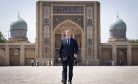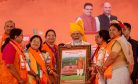





Mongolians have long dismissed their country as a pony between two elephants. But a wealth of natural resources could change that.
In the past month, Mongolia has played host to an impressive succession of visiting world leaders, including senior officials from China, the United States, South Korea and Finland. Movers and shakers in government and business from around the world are taking unprecedented interest in Mongolia. Why?
As industrialized countries scour the globe for increasingly scarce raw materials, Mongolia is seen as a generously endowed partner that is eager to do business. The physically massive but undeveloped country is enjoying the attention as it extends its brand of resource diplomacy. All recent visitors left with plans to extend ties and get their piece of Mongolia’s mineral pie.
The recent meetings were feted by their participants and in the Mongolian press with some gushing rhetoric, with much talk of ‘historic’ agreements and ‘special relationships.’ During his meeting with Zhou Yongkang, a senior official of the Chinese Communist Party, Mongolian Prime Minister S. Batbold spoke of a coming ‘golden era’ in Mongolian-Chinese relations, which have historically been antagonistic.
Batbold also referred to South Korea Mongolia’s ‘third neighbour.’ Shortly after South Korean President Lee Myung-bak’s visit, the country’s state-run Korea Development Bank (KDB) announced the signing of a contract with the Development Bank of Mongolia (DBM) to manage DBM for four years.
Under the deal, inked on August 30 in Ulan Bator, KDB will remake the bank’s operating system and take control of its development financing side. An official from KDB stated that the contract would be extended ‘if necessary,’ though what might constitute necessity wasn’t explained.
US Vice President Joe Biden, meanwhile, praised Mongolia’s democracy by calling the country ‘an emerging leader in the worldwide democratic movement.’ The United States plans to share its expertise in high technology in return for deals related to Mongolia’s natural resources.
On the same day as Finnish President Halonen's visit, the Mongolian government announced plans to raise $300 billion by privatizing Erdenes Tavan Tolgoi, the company in control of one of the world’s biggest coal deposits. The company will be listed on the stock exchanges of London, Hong Kong and Ulan Bator. This spreading of associations perhaps sends the message that Mongolia wishes to keep a range of partnerships, rather than being seen to rely on one partner.
Mongolians have described their country as a tiny pony stuck between two huge elephants, namely Russia and China. Mongolia became a Soviet satellite after it looked to the victorious Bolsheviks for protection from China. The Chinese government at the time wanted to claim both Inner and Outer Mongolia as Chinese territory. Much of Mongolia’s history is therefore comprised of being pulled between larger powers. Now, though, the country is using its mineral wealth to carve out an independent global position.
Mongolia’s economy has been predicted by the European Bank for Reconstruction and Development to grow by 9 percent this year, and 12 percent in 2012, as a result of increased activity in the mining sector.
Yet despite such impressive numbers, the capital of Ulan Bator doesn’t look much like a prosperous city. The city centre is rife with abandoned buildings and a huge, growing slum sits on its edge. More and more Mongolians are finding it impossible to continue with their traditionally nomadic way of life, while extremely harsh winters have killed herders’ animals, leaving them with no option except to migrate to the city, where they generally fail to find work and end up living in poverty.
‘Once they get here, they’re stuck. They can’t go back to being a herder,’ says Troy Tvrdik, who with his family runs the NGO Flourishing Future in Ulan Bator’s ger (traditional Mongolian hut) district. ‘Then all of a sudden they wake up and have nothing to do. They lose all sense of purpose.’
On August 27, Mongolian Finance Minister S. Bayartsogt announced that the government plans to invest the budget surplus into welfare measures designed to improve employment and health. In July, revenues were MNT 248.8 billion ($199.8 million) more than projected, due to big increases in industrial and mining production.
The government says it will increase spending by up to MNT 92.6 billion ($74.4 million), with MNT 30 billion to be allocated for programmes to boost employment, MNT 10.3 billion ($8.3 million) to be used to improve transportation and health for vulnerable Mongolians, and MNT 1 billion ($8 million) set aside to help Mongolian athletes prepare for the 2012 Olympic Games.
Of course, despite the recent interest and pledges of investment, Mongolian officials have a long way to go in trying to create a broadly successful society while relying on industries that employ few people and are often foreign-owned. Still, the decisions and relationships now being made in Mongolia will determine whether it can become one of the big elephants of the global economy, or if it is destined to remain a tiny pony.
Steven Borowiec is a South Korea-based writer. His work has appeared in The Guardian, The Toronto Star and Asia Sentinel, among other publications.
Photo Credit: Benutzer:Aineias


Louis
“hopes to raise $300 billion”? I think you mean $3 billion.
Bat
@jason miks
The Chinese are allowed to insult and humiliate everybody around: Tibetans, Mongolians, Uighurs, His Holyness Dalai Lama, Madam Rebiya Kadyr, and many others. When these exploited and humiliated peoples respond, they are suddenly labelled as “attacks on individuals and countries”. This is unfair!
This is my last message to this site – the Diplomat. Without my comments, your articles on Mongolia and her mortal enemy for thousands of years will remain uread without comments. But that is your problem! Good luck in promotion of the Chinese communist lies and propaganda around the world! The good news is that the people in free dmeocracies are intellectually mature enough to believe in the Chinese communist, nationalistic and racist lies!
Huang
Hey Bat,
Why leaving so soon? Before you leave,(and not pop up as someone pretending to a Tibetan the next time)I have a few thing I would like to share with you. Remember,there is nothing personal about the following:
If you play with fire,don’t cry when you get burned.
If you play with tricks,you will be caught red-handed. If you lie,you’ll be exposed If you play with poison,you will become ill or even killed.
If you play with your emotions,you will make poor choices.
If you play with your mind,you will go mad.
If despise China(for the wrong reason),you will be sorry.
If I play with your mind,you will become smarter.
ozivan
@Huang. Well said.
Liu
China is a very powerful country…i am proud to be chinese…we will control all of mongolia one day because we are a ruthless power hungry corrupt country…beware of us…and US if you want to stop us do what you did in hiroshima and nagasaki..
Huang
@pretending to be Liu,
Be careful of what you wish for because what ever ills you have been wishing will be coming down at your head in your country of origin.
yang zi
I love Mongolians, I myself has the blood. but not Bat, so I called Bat a name, which Mr. Miks removed. I also protest! (guess Mr. Miks is right? since Bat also protested)
John Chan
@Bat:
Jason Miks’ warning is given to everyone on this site, he did not target at you, why are you so defensive? Is it because you have done something wrong?
The discussion here is about promoting peace and prosperity for mankind, it includes Chinese as well as Mongolian. Mongolia and China are good neighbour, China will do its best to help Mongolia improving its living standard, it is a given, there is nothing Indian can do to derail such good spirited cooperation.
ozivan
@Bat. I believe Jason Miks has a difficult task as a moderator.
Believe me, Jason has deleted a number of my posts too when I got incensed by some rude unreasonable bloggers. In fact, one of my comments posted here which was to rub you further was disallowed by Jason.
We win some of the times, and we lose some of the times. But usually, we learn more and improve along the way.
Bat..please stay, and don’t give up. Because of internet, the world has become more interactive, and whatever bloggers have commented, however ugly they may be, we can and must forgive each other. You’re still an Asian brother to us.
My friend…The world will respect Mongolians wherever they are.
Jason Miks
We appreciate the time our readers take to comment on our articles, however we’d also like to remind some readers that we strive to create an environment where all views are respected and debated sensibly. Some of the comments recently have been attacks on individuals or countries, and we won’t tolerate this.
But thank you again to all those readers making sensible and informative contributions.
John Chan
Absolutely, it is everybody’s responsibility to maintain the quality of this site be it writers or readers. Civility and objectivity are the route to debate meaningfully.
Peter
@ John Chan With all you have said – I am sure that you can understand the desire of these various peoples to be free from China’s domination, even if you don’t agree.
Granted, China has also given (perhaps more than it has taken – at least historically), but people want to be free. They want to determine their own national destiny. Do you seriously think that Mongolians (or Tibetans, Taiwanese and Xinjiangren) would want to reunite with Inner Mongolia and be ruled by Beijing?
There is only one reason why Beijing controls Tibet and Xinjiang and is able to intimidate Taiwan – military strength – history, culture, everything else is all just propaganda nonsense.
I am sure their own societies are full of problems and they may be much worse off than China – but with China all you get is a CCP dominated culture of corruption where the only way for most people to succeed in life is to bribe their way.
Your comments about mongolians selling out their culture are not fair. How can you expect a nation that has been bullied and dominated by foreign powers for so long to maintain its cultural distinctiveness – China can’t even do that. These days 肯德基 is more Chinese than 北京烤鸭.
In addition, China has destroyed many native cultures (Manchu – just to name one) and even abandoned it’s own writing system – though I am very thankful for this last one since 繁体字 is absurdly archaic and difficult, especially for a non-native speaker.
You show a very strong bias in your analysis.
yang zi
@Peter, I don’t disagree with your thinking, it makes sense from an outside point of view.
However, if you read any Chinese history (I am sure you did), you know these nomadic tribes (Mongolian, Tibet etc) have savaged, harassed, looted and destroyed Chinese proper since the written history began. China can not allow these happen anymore, this is a two thousand year lesson if you will. if only because of Chinese military power keeps them under control, so be it.
I think a new China is emerging, where these nomads and Han Chinese can finally coexist as one, no more great walls. just the great wall of Chinese military. I like it.
John Chan
@Peter:
“United we stand, divided we fall.” There are plenty of selfish people who want to satisfy their personal gains at the expenses of the general public. Therefore separatists want to be free from association with China; they need to fight for it by themselves, not by leveraging on the foreigners or via foreigner’s dictation. Outer Mongolia, Vietnam and Korea are the examples that succeeded in separating from China; it is no difference elsewhere in the world. USA civil war is another example; southerners failed their bet to be free from northerners’ domination.
Tibet, Xinjiang and Taiwan are integral parts of China, your reasoning regarding the relationship between those three places and China is wrong. China’s wish to reunite Taiwan is the same desire as the Germans’ wish to reunited West and East Germanys. Taiwan’s current awkward situation is because China is not strong enough to overcome USA’s interference. Any foreign interference to undermine China will be resisted and defeated.
China has always been changing by adopting and innovating, that’s why Chinese is the only oldest surviving civilization in the world. When China failed to change as during the late Qing, it would go into deep troubles until next renaissance.
Bat was asking for the brutal reminder of his national disgrace. Difficult situation is not an excuse to lose one’s cultural identity, writing.
My opinions are realistic and moderate; please keep your opinionated judgement to yourself.
ozivan
Author Steven wrote : Mongolians have long dismissed their country as a pony between two elephants.
Interestingly, in politics, funny that those with the least leverage or influence often express frustratingly a similiar predicament :
There are like Grasses to the 2 Elephants.
When the elephants fight, the grasses get trampled on.
When the elephants make love, they similarly get trampled on.
John Chan
@Bat:
You questioned the accuracy of the events in the article, and asked for local media reporting as a proof of accuracy, yet you is spreading your hateful anti-China venom recklessly, accusing a Chinese visiting minister baselessly and made out of crimes thru the thin air, it seems objective reporting is out of window when it comes to his turn of reporting. What a joke and hypocrisy.
This article is about Mongolia’s attempt to walk a fine line and coexist between the elephants as a small donkey, and Mongolia’s attempt to improve the life of its herders who lack the capabilities to adjust modern living, yet you diverted onto anti-China rhetoric rampage instead of talking about how to leverage China’s advances to help Mongolia.
Comparing the living standard of Inner Mongolia with Outer Mongolia is like comparing South Korea with North Korea(Outer Mongolia), luckily there is a fence at the border between Mongolia and China, otherwise Mongolia’s propulsion might drop by half overnight. The best way to improve Outer Mongolians living standard is to merge Outer Mongolia into Inner Mongolia again.
At the same time the Inner Mongolians will wonder why they would want to look to Outer Mongolia as a savoir, a group of nomadic tribes that even cannot protect their ancestor’s culture, it is totally assimilated by Russian, they sold out their ancestor’s writing and used Cyrillic script instead, meanwhile the Inner Mongolians are still maintain their own culture under the roof of China.
Another point regarding history: Great Wall was build 300 years before Christ, after that Han Emperor Wu sent expedition forces thru the gates of Great Wall to expel Xiongnu (Mongol’s ancestor). After the great expel, Xiongnu was a non-factor for more than a thousand years until the arrival of Temujin. The corrupted and incompetent Mongol was expelled and hunted again by Ming. Mongols would not survive if they did not accept China’s suzerainty all those years. Lastly China’s Qing put Mongolia under direct administration. It is not surprising for your story-like version of history, because Outer Mongolians have lost link to their ancestor’s writing, so you just make things up on the go.
from Mongolia
Dear John Chan ,
You have made mistake. Living standart of Mongolians is much better from that of inner mongolians. Usually , there is tight border contral between Mongolian and China to prevent chinese immigrants to enter Mongolia. But we have chinese construction workers who are working under 2 governments agreement because salary for them is higher than in China.
from Mongolia
Dear John Chan,
In addition, Mongolians look down at inner mongolians because they are traitors. One day Inner Mongolia will be free but we Mongolians want that inner mongolians build their own independent country without integration with Mongolia.
Loraine
I recently taught at a Chinese university for three years (I am an American professor). The last semester four Mongolians attended my English classes (they were business professionals). Their last day I invited them to a Chinese restaurant on campus. I could not read the menu, but each dish had pictures, so I pointed to several dishes (all diners share each dish). So one of the dishes I ordered was “snake and noodles.” They loved it, but I HAD to decline.