
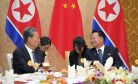


Will the upcoming change in Chinese leadership prompt a dramatic shift in China's foreign policy? History suggests it could.
In about a year’s time, a new group of leaders in Beijing will succeed President Hu Jintao and Premier Wen Jiabao. At the moment, analysts are focused primarily on the make-up of the nine-member Politburo Standing Committee, the supreme policy making body of the Chinese Communist Party (CCP). Vice President Xi Jinping and Executive Vice Premier Li Keqiang, both members of the standing committee now, are assured of succeeding Hu and Wen, respectively. As a result, the guessing game that has engrossed many China watchers is over who will replace the other seven retiring members.
Speculating about top personnel decisions is both risky and not all that interesting. Such decisions are reached through intricate factional bargaining and compromises, and the ultimate outcome is typically not determined until the very end. Worse, handicapping the chances of frontrunners usually distracts us from trying to understand the broader policy implications of leadership transition. We become too preoccupied with the shifting fortunes of factions within the CCP leadership to explore whether leadership change actually affects policy.
So a more fruitful way of getting ourselves prepared for China’s upcoming leadership transition is to look back at history and examine whether the past top leadership changes resulted in significant foreign policy changes, and what explained such major shifts.
Unfortunately, we don’t have a lot of data points here. The CCP has experienced only four leadership transitions: from Mao Zedong to Hua Guofeng (1976), from Hua to Deng Xiaoping (1979), from Deng to Jiang Zemin (1994-95), and from Jiang to Hu Jintao (2002). Of the four cases, only the last three should count because Hua, a transitional figure, didn’t have a real chance to remake Chinese foreign policy.
When we look at the three meaningful leadership transitions, the greatest change in foreign policy occurred when Deng took over power in 1979. He normalized relations with the United States, fundamentally reoriented Chinese foreign policy in a pro-Western direction, ended Chinese support for leftist forces around the world, and launched a punitive, albeit costly, war against Vietnam. In addition, he articulated a new strategic principle: Chinese foreign policy is to serve the country’s economic modernization. (His famous dictum on keeping a low profile was prescribed after the collapse of the former Soviet Union, more than a decade later).
The transition from Deng to Jiang in the mid-1990s didn’t bring about a fundamental shift. (Deng was too ill to influence policy by 1994, even though he didn’t die until 1997). Still, there were minor but important adjustments. Jiang moved China closer to the West and accelerated its integration into the West-dominated international system, culminating in the accession into the World Trade Organization at the end of his tenure, perhaps his most enduring legacy.
Another notable shift under Jiang was China’s regional diplomacy. He upgraded China’s ties with Moscow, and opened China’s charm offensive toward ASEAN nations. But, at the same time, Jiang adopted a tougher stance toward Japan and was blamed for the rapid deterioration in Sino-Japanese ties under his watch. On Taiwan, Jiang initially tried to reach out to Taiwan’s new leader, Lee Teng-hui, but Lee’s turn toward a more pro-independence stance in the mid-1990s forced Jiang to take a much harder line.
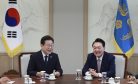
Photo Credit: White House
View as Single Page


Chang
You argue that ’succession at the top of the CCP does have real consequences’. However, don t you think most of the innovations realized by Chinese foreign policy has been made in response to internal or external factors and not voluntarily planned changes?
The Charm offensive in the 90’s was not a prime choice but a consequence of CHina’s isolation following the Tiananmen events.
You focus on China’s foreign policy towards Taiwan, but the strategy Hu adopted was not ‘his’ innovation but a response to Taiwan’s radicalization under Lee and Chen. Jiang would have certainly done the same…
Hu was more American than Jiang but maybe because the context was different. Following the 9/11, it was in the interests of China to get closer to the US in order to divert them from Asia and to have a good reason fighting against what is called ‘terrorism’ in Chinese inner provinces.
I belive we should not overestimate the capacity of leaders to shape their foreign policy, all the more in China where five years plan and long term objectives are adopted. In democracies, the situation might be different because of the need to rely on public opinion, to differentiate from other political parties etc… But in China, foreign policy does not change with a new leader because the national interest of China stay the same.
Chinese leaders do not shape foreign policy, they just adapt it.
vokoyov
They are an inalienable part of China’s territory according to historical facts and international law; Japan’s claim untenable ———–
Situated in the East China Sea, due east of Fujian province and northeast of Taiwan, the Diaoyu Islands are the farthest eastern islands of China. They are about 190 nautical miles from the Dongshan Island of Fujian province, 90 nautical miles to the northeast of Keelung city of Taiwan, and 78 nautical miles from the Yunaguni Island of the Ryukyu Islands. The Diaoyu Islands refer to a group of islands that include the main one, Diaoyu Island, and some smaller islands and reefs like Huangwei Island, Chiwei Island, Beixiao Island, Nanxiao Island and three other islets. They are scattered in a sea area at 123 degrees 20 minutes ~ 124 degrees 45 minutes east longitude and 25 degrees 44 minutes ~ 26 degrees north latitude, covering a total land area of 6.5 square kilometers. The surrounding waters of the islands have rich fishing resources and have long been an important fishing ground for people in Fujian and Taiwan of China since ancient times. The well-known Emery Report pointed to the existence of abundant oil and natural gas resources on the continental shelf of the East China Sea.
(1) The Diaoyu Islands are an inalienable part of China’s territory.
China was the first country that discovered and explored the Diaoyu Islands and obtained sovereignty by occupation. Since ancient times, the Chinese have fished, collected medicinal herbs and sought shelters on these islands and in their surrounding waters. No later than the Ming Dynasty (1368-1644), the islands had been discovered, explored and named by the Chinese. Ancient Chinese books, such as the Book on Voyage Routes and the Voyage with a Tail Wind, kept a complete record of the navigation routes used by Chinese fishermen in this sea area. Due to the natural conditions at sea and the possession of technology such as ship-building at that time, only the Chinese military and civilians could reach the islands during the monsoon season. They navigated through the islands and sought haven there in stormy weather. They carried out economic activities such as fishing, collecting herbs and picking fruits. For about five centuries until 1895, China had never been interfered in its exercise of these rights.
One cannot speak of the Diaoyu Islands without mentioning Ryukyu Kingdom. Ryukyu Kingdom was a vassal state of the Ming and Qing dynasties to which it paid tributes, while the latter sent envoys to grant honorific titles to the kings in Ryukyu in recognition of their rule. The Diaoyu Islands were on the navigation route from China’s mainland to Ryukyu Kingdom. Chinese officials on mission to Ryukyu all referred to these islands as their navigation marks. They put down in the official documents such as the Record of the Mission to Ryukyu with detailed descriptions of their voyages through the Diaoyu Island, Huangwei Island and Chiwei Island and repeatedly confirmed the boundary between China and Ryukyu. Historical facts tell us that the Diaoyu Islands do not fall into the domain of Ryukyu. China’s historical records and official documents all show that it was the Chinese people who first discovered, developed and utilized the Diaoyu Islands. According to the international law of that time, discovery means occupation and occupation means obtainment of territorial sovereignty. Therefore, China obtained sovereignty over the Diaoyu Islands by occupation.
The Chinese government exercised effective rule and administration, and strengthened its sovereignty over the Diaoyu Islands. Successive Chinese governments all included the Diaoyu Islands into the confines of China’s territory and exercised sovereignty and effective rule by taking measures to develop, utilize and administer the islands. In 1171, General Wang Dayou guarding Fujian established military camps on Penghu Islands and sent officers to station in the islands. Taiwan and its affiliated islands including the Diaoyu Islands were under the military command of Penghu and, in terms of administration, they were under Jinjiang of Quanzhou, Fujian province. Both the Ming and Qing dynasties incorporated the Diaoyu Island and its affiliated islands into their territory and designated them as part of the maritime defense areas. The Book on Managing the Sea (1562, Ming Dynasty) and Imperial Map of Chinese and Foreign Lands (1863, Qing Dynasty) made clear descriptions about the area. Historical facts show that the Chinese government has administered the Diaoyu Islands in various ways and effectively exercised and strengthened its sovereignty over the Islands.
(2) Japan’s arguments about its claim of sovereignty over the Diaoyu Islands are untenable.
There are mainly two legal arguments that Japan has evoked to justify its occupation of the Diaoyu Islands: First, occupation of so-called terra nullius, second, acquisition by prescription (prescriptio acquisitive). Both arguments are untenable.
By international law, the object of occupation shall be limited to terra nullius. Terra nullius refers to land which has never been subject to the sovereignty of any state or over which any prior sovereign state has expressly or implicitly relinquished sovereignty. The fact is that Diaoyu Island and its affiliated islands have been subject to the sovereignty of the Chinese government as its sea defense area since the Ming Dynasty. They are an inalienable part of China’s territory. Due to the inhospitable natural environment, these islands are not permanently inhabited and fishermen only take up abode on these islands for seasonal activities. But having no permanent residents does not make these islands terra nullius. The Diaoyu Islands are not terra nullius. They are China’s territory. The Japanese government and society are well aware of this fact. The official archives of the Japanese government and documents and correspondence of Japanese officials all record and give evidence to this. For example, in the letter to Home Minister Aritomo Yamagata, then Japanese Foreign Minister Kaoru Inoue wrote in explicit terms that these islands had already been given Chinese names by the Qing government and that the Japanese government had been admonished by the Qing government for coveting these islands. Since the Diaoyu Islands are not terra nullius, Japan’s so-called occupation is non-existent. Ex injuria jus non oritur (A legal right or entitlement cannot arise from an unlawful act or omission) is a fundamental principle of international law. Japan’s so-called occupation is mala fide, illegal and unjustifiable; it therefore does not have the legal effect as what may arise from occupation recognized by international law.
The other argument that Japan presents is “long and continuous effective administration”, that is, to obtain sovereignty over the Diaoyu Islands based on acquisition by prescription (prescriptio acquisitive).
“Acquisition by prescription” of territory has been all along an extremely disputable issue in international law. Those against it totally deny the legitimacy of prescription as a way to obtain territory. They are of the view that this is “merely a legal argument serving expansionist countries for occupying others’ territories”. Those for it see prescription as a way to obtain territory, it is defined as “the acquisition of sovereignty over a territory through continuous and undisturbed exercise of sovereignty over it, and during such a period as is necessary to create under the influence of historical development the general conviction that the present condition of things is in conformity with international order.” International judicial practice has never clearly confirmed the status of “prescription” as an independent way to acquire territory. As for the exact time span of the “period as is necessary”, international law has no final verdict to make it 50 years or 100 years.
If we put aside the legitimacy of “acquisition by prescription” and merely examine the key factors, it is clear that both the Chinese central government and the Taiwan local authority have been firm, explicit and consistent on issues concerning China’s sovereignty over the Diaoyu Islands and in opposing Japan’s attempt to steal them. They have launched protests, especially diplomatic protests, against official and government-supported civilian activities, including setting up a lighthouse on the Diaoyu Island by Japanese right-wingers, “nationalizing” the lighthouse by the Japanese government, paying the “rent” for land on the Diaoyu Islands to those so-called non-governmental owners, and submitting a chart specifying the so-called baselines of the territorial sea of the Diaoyu Islands to the United Nations by the Japanese government. Japan can never gain legitimate rights over the Diaoyu Islands through occupation no matter how long it may last.
(3) Agreements between Japan and the United States cannot grant Japan sovereignty over the Diaoyu Islands.
In the wake of World War II, the Cairo Declaration and the Potsdam Proclamation, the outcome of the Anti-fascist victory clearly defined the territory of Japan. According to the Cairo Declaration issued by China, the US and the UK in December 1943, their purpose is that “Japan shall be stripped of all the islands in the Pacific which she has seized or occupied since the beginning of World War I in 1914, and that all the territories Japan has stolen from the Chinese” shall be restored to China. “Japan will also be expelled from all other territories which she has taken by violence and greed”.
The Potsdam Proclamation issued in 1945 reaffirmed that “the terms of the Cairo Declaration shall be carried out and Japanese sovereignty shall be limited to the islands of Honshu, Hokkaido, Kyushu, Shikoku and such minor islands as we determine”. On Jan 29, 1946, the Supreme Commander for the Allied Powers Instruction No 667 explicitly stipulated the range of the Japanese territory, which included the four major islands of Japan (Honshu, Hokkaido, Kyushu, Shikoku) and the approximately 1,000 smaller adjacent islands, including the Tsushima Islands and the Ryukyu Islands north of 30 degrees north latitude. The delimitation of the Japanese territory by the Cairo Declaration and the Potsdam Proclamation is clear-cut. The Diaoyu Islands are not included in the Japanese territory in any way.
On Sept 8, 1951, Japan and the US concluded the San Francisco Peace Treaty in the absence of China and the Soviet Union, two victorious countries in the war against Japan, putting Nansei Shoto south of 29 degrees north latitude (including the Ryukyu Islands and the Daito Islands) under the US trusteeship. The Diaoyu Islands were not mentioned in the treaty, nor by the Japanese government’s later explanations thereof. On Dec 25, 1953, the United States Civil Administration of the Ryukyu Islands issued the Civil Administration Proclamation No 27 on the geographical boundaries of the Ryukyu Islands and defined the areas administered by the US government and the Ryukyu Civil Administration as the islands, islets, atolls, rocks and territorial waters along 24 degrees north latitude and 122 degrees east longitude. This proclamation included the Diaoyu Islands, China’s territory, into their areas of administration. These islands were also included in the areas to be returned to Japan under the Japan-US Okinawa Reversion Agreement signed on June 17, 1971. The Japanese government takes the above-mentioned agreement as the legal ground for its claim of territorial sovereignty over the Diaoyu Islands.
On Dec 30, 1971, the Chinese Foreign Ministry pointed out in its statement that “the incorporation by the United States and Japan of China’s Diaoyu and other islands into the area of reversion under the Okinawa Reversion Agreement is totally illegal. It does not in any way change the territorial sovereignty of the People’s Republic of China over the Diaoyu and other islands”. The US government also stated that returning the administrative authority over these islands gained from Japan to Japan does not in any way undermine relevant sovereign claim. The United States cannot increase the legal right Japan had prior to its handover of the administrative authority over these islands to China, nor can it undermine the right of other claimants because of the return of the administrative authority to Japan. All the conflicting claims over these islands are issues that should be resolved by the parties concerned among themselves. On Sept 11, 1996, US State Department spokesperson Nicholas Burns said further that the US neither recognizes nor supports any country’s sovereign claim over the Diaoyu Islands.
On Sept 1951, the Chinese government issued a statement regarding the San Francisco Peace Treaty signed by the US and Japan without the involvement of the Chinese people and the lawful government of China. It pointed out the illegal nature of the treaty. The “trusteeship” and “reversion” deriving from the treaty included the Diaoyu Islands, thus violating China’s territorial sovereignty and becoming the source of the territorial dispute between China and Japan. The San Francisco Peace Treaty and other relevant documents have no right to cover or determine the ownership of the Chinese territory, and cannot have any legal judgment that extends the sovereignty of Diaoyu Islands to Japan.
The Diaoyu Islands are an inalienable part of China’s territory. The so-called administrative authority the US “got from” and “returned to” Japan is unjustified. Japan’s claim over the sovereignty of the Diaoyu Islands on that basis has no legal ground in international law.
Conclusion
Japan has never given up its attempt to gain sovereignty over the Diaoyu Islands. It first destroyed China’s markings on the islands, then renamed the islands, and built a heliport and other facilities. In recent years, Japan went even further. It abetted what it called “civilian actions” to create a fait accompli of “actual control” of the Diaoyu Islands, followed by government renting and “takeover” actions. All this aim to pave the legal grounds for its occupation of the Diaoyu Islands and gradually win recognition from the international community. However, Japan’s claim to sovereignty over the Diaoyu Islands and its encroachment are illegal in the first place. Therefore, its carefully designed “government actions” have no legal ground and do not constitute the execution of state power. They never had, and will never have, any legal effect.
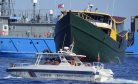
Article II of the Law of the People’s Republic of China on the Territorial Sea and the Contiguous Zone promulgated in 1992 makes clear that the Diaoyu Islands and other islands are Chinese territory, and reaffirms the legality of China’s ownership of them. In 2009, a Chinese marine surveillance and law enforcement ship was sent to the Diaoyu Islands in repudiation of Japan’s “acquisition by prescription”. This was also a concrete action of China’s exercise of sovereignty over the Diaoyu Islands.
John Chan
Taiwan Lee Teng-hui is a closet Japanese; Lee’s mission was to sell Taiwan to Japan.
The article is a narrative of Chinese foreign policy changes from Deng to Hu. It is not about Chinese foreign policy after Hu. The article flattered USA a lot for the work they did not do and gave USA a lot of credits they did not deserve.
I believe the majority Chinese wish the foreign policy of China’s next leadership should be focused on reuniting Taiwan within a decade and recovering all territories within the nine dashed-lines in the South China Sea within a decade too.
Sinodefender
Lee Teng-hui and all that served the IJA in Taiwan are Han jian… Speaking to relatives about reunification is that many want to retain the status quo in Taiwan. Wait a few decades, foster friendship then will the 2 “China’s” be reunited.
S. Wang
I disagree with the last comment about how foreign policy is less susceptible to pressure than domestic, in fact, increasingly, with China’s growing confidence and rise, Chinese nationalism is having ever more influence on how Chinese leaders are choosing to position themselves. E.g. Defending national sovereignty in maritime East Asia, in the islands, to appear strong against Japan, U.S., etc.
Also, while indeed, it appears the past has shown there is flexibility for leadership, the trend, I believe, is definitely moving towards one of gradual normalization of a general doctrine in which the next couple generations of leadership are unlikely to seriously change (if only because they have very similar backgrounds as political technocrats, and neither revolutionaries of the past nor yet the new social and economic up-comers from outside.)
Frank
The next Chinese leaders are not push over for sure.
However, I think they will be nicer to Taiwan. Mainland and Taiwan will get closer than ever. The missiles facing Taiwan will be moved to Hainan or Tibet soon.
莫慌张
Hainan ? I think you mean Nanhai ,right?Cause hainan is a province.
Frank
Hainan is an island looks like a fist moving towards to soft belly of Vietnam.
Most part of Vietnam is in striking distance of Hainan island.
GrassMudHorse2CCP
You’re so naive!The CCP is evilest you can ever imagine!
yang zi
good piece!
it would be better if the author can speculate what changes will come.
I suspect China will be more tough, but still maintain a polite veener. There might be a rapid military build up, may be a fundamental change in strategic forces, with big upgrades in nuclear strike capability.
this change will bring the lasting stability between China and US, even though it seems confrontational at first
Miguel Ángel del Pozo
…this paragraph is important to go into it, analisis it and “wait and see” till next year changes…”…Top elites tend to have a consensus on the need for such a shift [about changes in chinese foreign policy though it is important to keep an eye into "the chinese seas" development geostrategic situations and neighbour behaviours plus United States involvement on these realities], and few entrenched groups (except for the powerful military) have acquired veto power over a new leader’s initiatives to rebalance or adjust China’s foreign policy…”
Leonard R.
I’m not sure where Hu Jintao’s foreign policy has been a success. But with the United States, Vietnam and the Philippines, his foreign policy (if that is what you call it), has been a disaster.
But I am confident China’s next generation of leaders have the talent, experience and expertise to take China’s foreign policy to the next level – a shooting war.
Tom Tran
Not quiet. It looks like they have done a good job at promoting nationalistic view by a series of blunders and aggressive behaviors towards many countries at the same time (should I list?), but that comes at a cost, very expensive one indeed. Needless to say, while countries are working out a regime to talk with each other, the atmosphere would never be the same, full of suspicion and mistrust, playing with time until the next outbreak, no matter how nice/smart a new leader would be. You cannot teach an old dog new tricks, that sort of things. The next question is: should China want to follow the same path to enforce its claim by power projection, then by force if it feels it has an upper hand in a regional conflict? or would it accept a quieter environment? where it could still be a de-facto ruler in the region without much provocation just to show that it is the boss. I tend to believe the second scenario would be a likely choice. Tactically, China can win a battle, diplomatic or shoot-out wise, but that is the worst choice with long term consequence can be far more than short-term gain. The realignment of many countries toward the US is evident that any misstep by China will only isolate itself as seen in the case of japan, vietnam, the Philippines and asean generally. Strategically, China need a stable environment without hostility around it to develop. China has no interest in stirring up the sea where it can be too costly to enforce. To do that, it has to gradually tone its voice down. It doesn’t have to be an U-turn, just genuine goodwill to do it.
Minh
Good arguments!
Reason
@ Leonard R.
Totally agree …. the next Gen of princelings are certainly gonna take it to the kinetic level.
Hey… am putting together a site that believes the Chimerica War is already in full swing… you wanna contribute?
Johnlewisy
Yep, the Chinese are definitely preparing for some kind of shooting war.
I wonder if America would invade Canada if we announce we want to take a Switzerland option on the event of war.
As for Chinese policies, China has already stirred up the Hornet nest quite a bit in these last couple years but the situation is still yet under reasonable control. It’ll be very interesting to see whether the new leader will go even further or will pursue a more…reasonable approach.
John Chan
@Leonard R:
Shooting war is American and Europeans’ foreign policy; they are bombing and killing indiscriminately everywhere. If you think shooting war is a higher level of foreign policy than foreign policy based on negotiation and peaceful means, then I would say that China’s next generation of leaders would disappoint you, their talent, experience and expertise is not at the level of American and Europeans’ barbarism.
Sinodefender
At least Chinese don’t bomb American embassy and blame it on old maps while U.S. back then had the most sophisticated military technology…
Frank
China has patient. Red necks do not.
If China did not start a shooting war, red necks will.
They did so in Tucson and Norway already.
When are you going to snap, Leonard?